

Savvy founders should understand the concept of share dilution — no matter where they are on their business journey. This is because dilution can directly affect a founder’s financial stake in their company.
Growing your business can take many forms: raising funds from investors, hiring new employees, or even acquiring another company. But each of these growth opportunities has something in common: the potential to dilute the existing shares of your company.
Before engaging in any activity that could dilute shares, it’s important to understand what share dilution means, when it happens, and how to manage it intentionally as your company grows.
What is share dilution?
Share dilution, also called equity or stock dilution, refers to a decrease in the ownership percentage of existing shareholders when additional shares of a company’s stock are issued. It typically occurs as part of an equity financing round or when a company awards stock options or grants to employees.
This can happen to shares owned by a founder, employee, or investor. In some cases, dilution can result in a founder or owner losing their majority stake in the company. That’s why understanding when dilution happens (and how to track it) is so important.
It’s also worth noting what dilution is not. Dilution doesn’t mean your shares disappear, and it doesn’t automatically mean your equity is worth less. In many cases, founders end up owning a smaller percentage of a company that is more valuable overall.
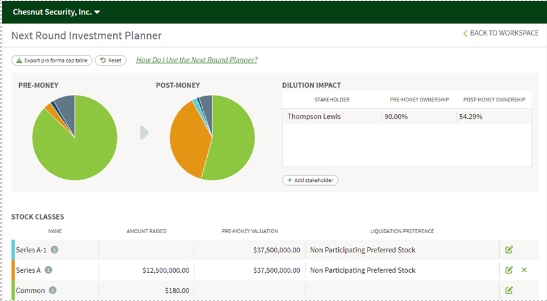
For example, the dashboard below shows the dilutive effect of a Series A financing round for a founder using the Fidelity Private Shares Next Round Planner. Although the founder's equity percentage decreased from 90%, they now own 54% of a much more valuable asset.
When does share dilution occur?
There are several common scenarios where share dilution occurs. In each case, dilution happens because new shares are issued, which means existing shares represent a smaller portion of the total ownership of the company.
Understanding these scenarios ahead of time can help founders avoid surprises and make more informed decisions.
When raising funding
Raising capital is one of the most common causes of share dilution.
When a founder offers investors equity in exchange for capital, new shares are typically issued. Those new shares increase the total number of shares outstanding, which reduces the ownership percentage of existing shareholders.
In addition to receiving equity, investors may also receive voting rights or other preferences that give them a greater say in the future of the business. This makes it especially important for founders to understand not just how much equity they’re giving up, but how that equity affects control and decision-making over time.
When increasing shares or options offered to employees
Equity compensation is a powerful tool for attracting and retaining talent, especially in early-stage companies.
Most early-stage companies create an option pool — often around 10–15% of total shares — specifically set aside for employees. Shares issued from an existing option pool aren’t considered new dilution because they’ve already been accounted for.
However, dilution often occurs when an investor requires the company to increase its option pool as part of a financing round. In many cases, those additional shares are allocated before the round closes, which means the dilution primarily impacts founders rather than new investors.
This is one of the most common areas where founders experience unexpected dilution, especially if they haven’t modeled the round in advance.
Other equity-based scenarios
Dilution can also occur when companies issue equity for reasons beyond fundraising or employee compensation, such as:
- Issuing shares to advisors or board members
- Using stock as part of an acquisition
- Converting convertible instruments like SAFEs or convertible notes into equity
Each of these events increases the total number of shares outstanding and should be factored into long-term ownership planning.

How share dilution affects ownership (with a simple example)
To understand dilution more concretely, it helps to look at a simplified example.
Imagine a company with 1,000,000 shares outstanding. A founder owns 500,000 of those shares, or 50% of the company.
If the company issues another 1,000,000 shares to raise capital, the founder still owns 500,000 shares — but now out of 2,000,000 total shares. Their ownership percentage drops from 50% to 25%.
While the percentage of ownership decreased, the founder may still be better off if the new capital significantly increases the company’s valuation. This distinction between ownership percentage and economic value is critical for founders evaluating dilution.
4 ways to manage share dilution for your company
Managing share dilution doesn’t mean avoiding it entirely. In most cases, dilution is a necessary part of growing a successful company. The goal is to manage it intentionally and with full visibility.
Here are four ways founders can stay ahead of dilution as their business grows.
1. Maintain an accurate cap table
An accurate capitalization table (cap table) is the foundation of effective equity management.
Your cap table shows how many shares exist, who owns them, and how ownership is distributed across founders, employees, and investors. Treating the cap table as a single source of truth allows you to:
- Understand current ownership at any time
- Model future fundraising scenarios accurately
- Avoid errors that can complicate diligence or financing
- Small business loans or lines of credit
- Grants
- Asset-based lending
- Revenue-based financing or recurring revenue loans
- Compare multiple fundraising options
- Understand tradeoffs before signing a term sheet
- Prepare for board and investor discussions with confidence
As companies grow more complex, many founders rely on cap table management software to keep this information accurate and up to date.
2. Understand financing alternatives
Traditional equity financing isn’t the only way to fund growth.
Depending on your stage and business model, non-dilutive or minimally dilutive options may be available, such as:
Venture debt may also be an option for later-stage companies, though it often includes warrants that can still be dilutive. Understanding these alternatives helps founders evaluate whether issuing new equity is the right tradeoff for their specific situation.
3. Plan for the long term
It’s easy to focus on dilution from a single round, but ownership changes compound over time.
Founders who plan ahead often look beyond the next raise and consider how multiple rounds might affect ownership over the life of the company. Having a realistic funding plan, grounded in a clear growth strategy, can help avoid issuing more shares than necessary.
Long-term planning also usually makes conversations with investors more productive, since expectations around ownership and dilution are aligned early.
4. Model dilution before it happens
One of the most effective ways to manage dilution is to model it in advance.
Scenario modeling tools allow founders to see how different variables—valuation, investment size, option pool changes, or future rounds—impact ownership outcomes. By modeling these scenarios ahead of time, founders can:
Some investors may also negotiate anti-dilution provisions to protect themselves in the event of a down round. These provisions can significantly affect founder ownership, making it even more important to understand potential outcomes before they become reality.
How Fidelity Private Shares Can Help You Manage Equity and Dilution
Managing share dilution can be easier (and far less stressful) when you have the right tools in place.
Fidelity Private Shares℠ offers an all-in-one equity management platform designed to support private companies as they grow. From maintaining an accurate cap table to modeling future funding rounds, the platform helps founders understand the impact of equity decisions before they’re finalized.
With Fidelity Private Shares, founders can:
- Dynamically maintain an up-to-date cap table
- Model future rounds and dilution scenarios with planning tools
- Manage 409A valuations
- Streamline due diligence with an automated data room
- Organize board members, stockholders, and equity plans in one place
Having clear visibility into ownership and dilution allows founders to focus less on administrative complexity and more on building their business with confidence. Explore the platform today.
409A valuations are conducted by a third party.
1162225.2.0